

Table of Contents
- Start With Your Eye Health Status, Not the Supplement Aisle
- AREDS2 Formula Benefits: What the Clinical Research Actually Shows
- Reading the Label: Lutein, Zeaxanthin, Zinc, and Omega-3s
- Safety of Eye Supplements for Seniors: Interactions and Absorption
- Budget-Friendly vs. Premium Eye Vitamins: What You Get for the Price
- When to See an Eye Doctor for Blurry Vision or Other Changes
- Frequently Asked Questions
Last Updated: September 16, 2026
Start With Your Eye Health Status, Not the Supplement Aisle
The most important step in choosing the best eye vitamins for seniors happens before you reach the pharmacy shelf: knowing what condition, if any, you are trying to address. At Clear Vision San Antonio, our team of dedicated eye doctors offers a comprehensive range of services to help you achieve clear vision for life.
Eye vitamins are dietary supplements formulated to supply nutrients that support retinal and macular health, most commonly lutein, zeaxanthin, zinc, and omega-3 fatty acids. They are not interchangeable; the right formula depends on whether you have age-related macular degeneration (AMD), cataracts, or neither.
Do You Have AMD, Cataracts, or Neither?
With intermediate AMD, an AREDS2-based formula is the evidence-backed choice. With early cataracts or no diagnosed disease, a general senior eye vitamin with lutein and zeaxanthin is a reasonable maintenance option.
| Your Eye Health Status | What to Look For | Why It Matters |
|---|---|---|
| Diagnosed intermediate or advanced AMD | Full AREDS2 formula with lutein, zeaxanthin, zinc, copper, vitamins C and E | Matched to the nutrient levels studied in clinical research |
| Early cataracts or family history | General eye vitamin with lutein, zeaxanthin, omega-3s | Supports macular pigment without high-dose zinc |
| No diagnosed condition | Standard multivitamin plus a lutein/zeaxanthin supplement | Avoids unnecessary high-dose minerals |
A common mistake is assuming a stronger formula is always better. High-dose zinc is in AREDS2 formulas because that population was studied with it, not because every senior needs it.
AREDS2 Formula Benefits: What the Clinical Research Actually Shows
The AREDS2 formula benefits come from a large-scale National Eye Institute trial testing whether a defined nutrient combination could slow AMD progression. The original AREDS study and its follow-up, AREDS2, established the nutrient levels most reputable manufacturers now copy.
What the research supports:
- A specific combination of vitamins C and E, beta carotene (later replaced with lutein and zeaxanthin), zinc, and copper was associated with slower progression of intermediate AMD to advanced AMD in the studied population.
- AREDS2 reformulated the original blend, removing beta carotene and adding lutein and zeaxanthin, partly because beta carotene was linked to higher lung cancer risk in smokers.
- The formula does not prevent AMD from developing, and it does not reverse existing vision loss.
That last point is where most marketing copy gets slippery. You can read the full study design and results through the National Eye Institute’s AREDS2 summary, which is the most reliable plain-language source on the topic.
If you currently smoke or recently quit, avoid formulas containing beta carotene. The AREDS trial linked high-dose beta carotene to an increased risk of lung cancer in smokers. Choose a lutein-based AREDS2 formula instead.
Reading the Label: Lutein, Zeaxanthin, Zinc, and Omega-3s
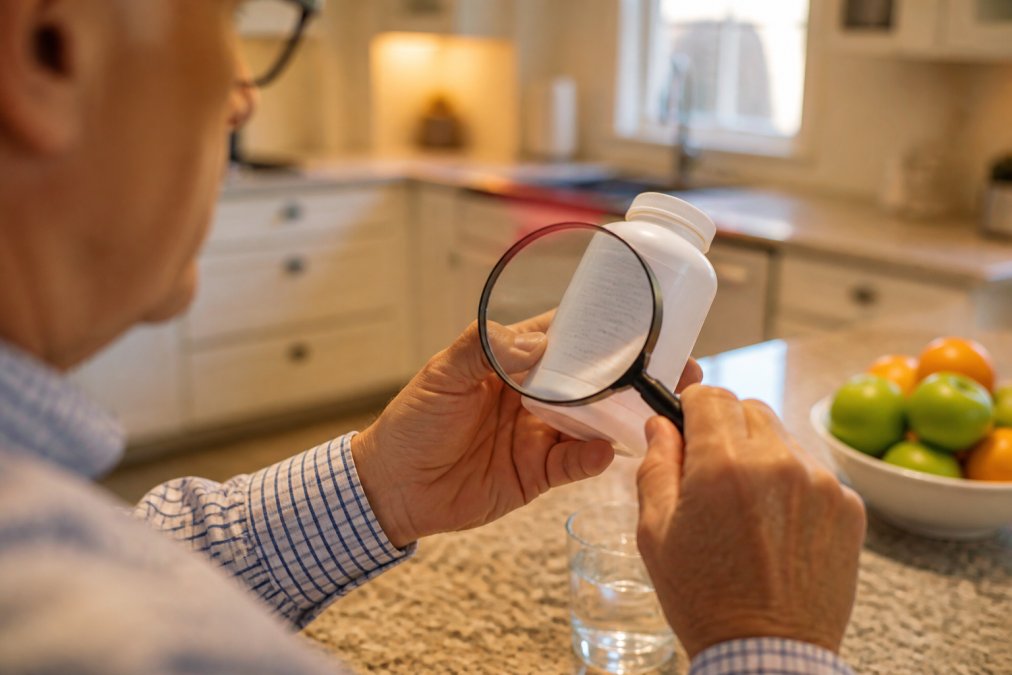
The front of the bottle tells you almost nothing useful. Turn it around and read the Supplement Facts panel.
Nutrients That Support Macular Pigment and Retinal Health
Macular pigment is the yellow layer of carotenoids at the center of the retina, built primarily from lutein and zeaxanthin from diet or supplements. These carotenoids are most directly tied to retinal health because the body deposits them exactly where central vision is processed.
Take your eye vitamin with your largest meal of the day. Lutein and zeaxanthin need dietary fat to absorb properly, and a meal with olive oil, eggs, avocado, or fish improves uptake compared with taking the pill on an empty stomach.
Safety of Eye Supplements for Seniors: Interactions and Absorption
The safety of eye supplements for seniors is about how ingredients interact with medications older adults already take, and how well an aging digestive system absorbs the pill. Most guides skip this angle, and it is where the real risk lives.
Medication Interactions: What to Watch For
Zinc is the ingredient most likely to cause trouble. High-dose zinc (AREDS2 uses 80 mg of zinc oxide) can interfere with antibiotics like tetracyclines and fluoroquinolones, and it competes with copper for absorption in the gut, which is why quality AREDS2 formulas include 2 mg of copper. If you take a diuretic, blood thinner, or medication for diabetes or hypertension, tell your eye doctor and pharmacist before starting any high-dose eye formula.
Practical checks before you start:
- Bring your full medication list to your eye appointment, including over-the-counter drugs, herbal products, and other supplements.
- Ask your pharmacist to run a interaction check specifically for zinc, vitamin E, and beta carotene against your current prescriptions. Most pharmacies offer this at no cost.
- Ask whether your eye formula duplicates anything you already take in a multivitamin, especially zinc and vitamin E.
- If you take a blood thinner, do not start a high-dose vitamin E or AREDS2 formula without clearing it with the prescriber who manages that medication.
Bioavailability: Why the Same Dose Does Not Always Work the Same Way
Bioavailability, meaning how much of a nutrient your body actually absorbs and uses, varies widely between products and between people. Two seniors can take the same 10 mg of lutein and end up with very different amounts reaching the retina.
If you take warfarin, clopidogrel, or another blood thinner, do not start a high-dose vitamin E or AREDS2 formula without checking with the prescriber who manages that medication. Vitamin E can add to the blood-thinning effect.
Budget-Friendly vs. Premium Eye Vitamins: What You Get for the Price
Price is a poor proxy for quality, but not meaningless. What separates a budget eye vitamin from a premium one comes down to third-party certification, ingredient sourcing, and delivery format. The goal is not the most expensive bottle; it is knowing which label claims are verifiable and which are marketing.
How to Verify Quality Before You Buy
Third-party certification is the most useful signal a senior shopper can look for, because it confirms what is on the label is actually in the pill. Two certification bodies matter most:
- USP Verified, the United States Pharmacopeia mark means the product has been tested for potency, purity, and dissolution (how well the pill breaks down in your gut). Nature Made Eye Health carries this mark.
- NSF Certified, NSF International tests for contaminants and label accuracy. You will see this on some sports and specialty brands.
- ConsumerLab.com, a subscription testing service that publishes independent reviews. Useful if you want a second opinion before buying.
What You Actually Get at Each Price Tier
| Tier | Typical Price Range | What You Get | What to Watch For |
|---|---|---|---|
| Budget | Under $15 | Single-nutrient or simple blends, often lutein only | May lack zinc, vitamin C, or omega-3s; check for USP or NSF mark |
| Mid-range | $15-$30 | Full AREDS2-style formulas, some with omega-3s | Verify the lutein and zeaxanthin amounts match the studied levels |
| Premium | $30+ | Specialty delivery formats, hypoallergenic formulas, clean labels | Higher price does not always mean better absorption; check the form of each nutrient |
A budget lutein-only product is not bad; it simply does less. It may lack zinc, vitamin C, and omega-3s, so it works best as an add-on to a multivitamin rather than a standalone eye formula. A premium product may use a chelated mineral or phospholipid delivery some seniors absorb better, but that advantage is not guaranteed.
Reading the Label Like a Buyer, Not a Marketer
Read the Supplement Facts panel and start with the amounts, not the ingredient names. A label listing lutein without a milligram figure is a red flag, as is a “proprietary blend” that hides individual doses behind a single number.
A few label checks worth doing in the aisle:
- Confirm lutein and zeaxanthin are listed with milligram amounts, not just names.
- Check whether the zinc is zinc oxide (the studied form) or a chelated form (often gentler on the stomach).
- Look for the USP or NSF mark on the front or back of the bottle.
- Check the expiration date and the serving size; some bottles list a serving as two or three pills, which changes the real cost per day.
Seniors who take a daily multivitamin and want targeted carotenoid support without duplicating zinc or vitamin C.
Pay for verification before you pay for marketing. A USP or NSF mark tells you more about a bottle than the price tag or the front-of-label claims ever will.
When to See an Eye Doctor for Blurry Vision or Other Changes
Knowing when to see an eye doctor for blurry vision matters more than any supplement decision. A vitamin cannot diagnose anything, and serious conditions like macular degeneration, glaucoma, and diabetic retinopathy produce few symptoms until damage is advanced.
Book an appointment if you notice:
- Sudden or persistent blurring in one or both eyes
- Straight lines appearing wavy or distorted
- New floaters, flashes of light, or a curtain over part of your vision
- Difficulty seeing at night or in low light
- Any change in color perception
Frequently Asked Questions
Do eye vitamins really work for seniors?
For seniors with moderate to advanced age-related macular degeneration, AREDS2-based eye vitamins can slow progression, according to clinical research. For those without AMD, the evidence is weaker. Eye vitamins are not a cure and do not replace a healthy diet or regular eye exams. Talk to your ophthalmologist before starting any supplement.
What ingredients should I look for in eye vitamins for macular degeneration?
Look for lutein, zeaxanthin, vitamin C, vitamin E, zinc, and copper in amounts matching the AREDS2 formula. Some products also include omega-3 fatty acids for retinal health. Avoid beta carotene if you smoke, as it may increase lung cancer risk. Check for third-party certification to confirm purity and potency.
Are there side effects to taking eye supplements?
High-dose zinc can cause stomach upset, and some seniors report nausea. Beta carotene may raise lung cancer risk in smokers. Certain ingredients can interact with medications like blood thinners. Always review your supplement list with your doctor or pharmacist, especially if you take prescription drugs for diabetes, hypertension, or other chronic conditions.
Should I consult my ophthalmologist before starting eye supplements?
Yes. An eye exam can reveal whether you have AMD, cataracts, or another condition that supplements may help. Your ophthalmologist can also check for interactions with your current medications and recommend a specific formula. Self-prescribing based on marketing claims may waste money or miss a treatable problem.