
Table of Contents
- What Is Cataract Surgery and When Do You Need It?
- Cataract Surgery Lens Options: Monofocal, Multifocal, and Toric
- Cataract Surgery Recovery Time: What the First Weeks Look Like
- Post-Operative Cataract Care Instructions You Should Follow
- Risks and Potential Complications of Cataract Surgery
- Financial Planning and Insurance Navigation for Cataract Surgery
- Frequently Asked Questions
Last Updated: September 12, 2026
What Is Cataract Surgery and When Do You Need It?
Cataract surgery is an outpatient procedure that removes a clouded natural lens and replaces it with a clear artificial one, called an intraocular lens (IOL). It is one of the most frequently performed eye operations in the country.
At Clear Vision San Antonio, we hear the same question constantly: “My cataracts aren’t that bad yet. Can I wait?” Often, yes. Cataracts usually develop slowly, and surgery is elective until the vision loss interferes with driving, reading, or managing your own medications. The National Eye Institute’s cataract overview puts it plainly: surgery is the only treatment that removes a cataract, and the decision to proceed is based on how much the cloudiness affects your daily life, not on a fixed timeline.
Symptoms That Point to a Cloudy Lens
Early cataracts announce themselves quietly: blurred vision a new glasses prescription no longer fixes, glare and halos around headlights at night, or colors that look faded and yellowed. Contrast sensitivity drops, so curbs and steps become harder to judge.
One symptom catches people off guard: a temporary improvement in near vision, sometimes called second sight. It fades. When reading, driving at dusk, or recognizing faces gets harder, that is the point to schedule a dilated eye exam.
How the Outpatient Procedure Works
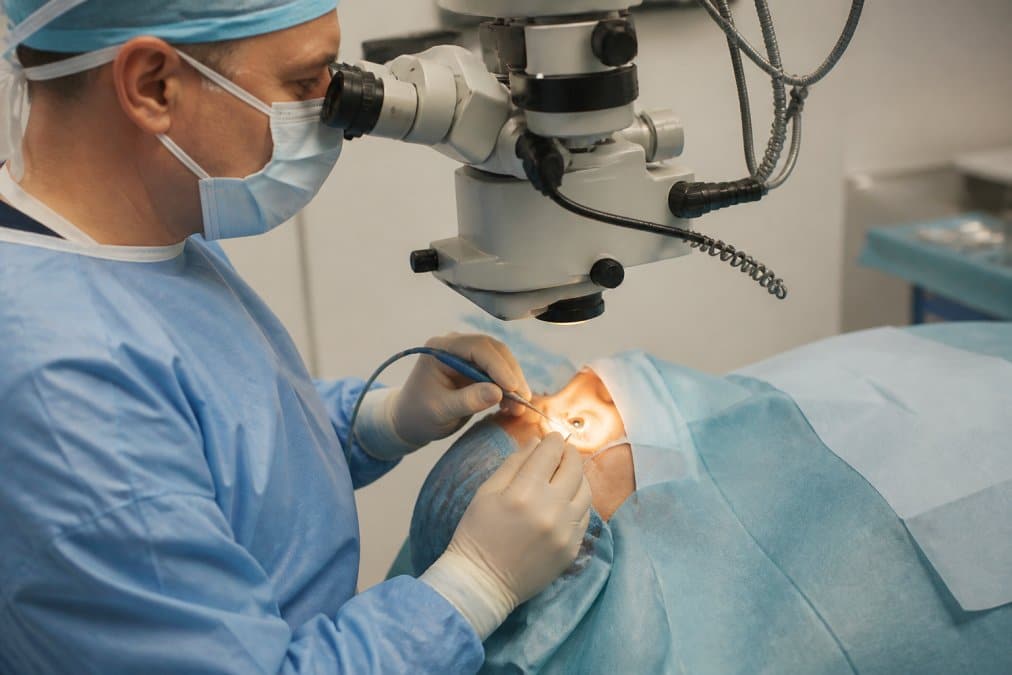
The most common technique is phacoemulsification. Your surgeon makes a small corneal incision, uses ultrasound to break up the cloudy lens, removes the fragments, and inserts the folded IOL through the same opening. The incision typically self-seals, so stitches are often unnecessary.
You will be awake, with local anesthesia and sedation for comfort. The procedure usually takes under 30 minutes per eye, and you go home the same day (nei.nih.gov). Most surgeons operate on one eye at a time, scheduling the second a week or two later.
Ask your surgeon who manages your eye drops after surgery. Ask your surgeon who manages your eye drops after surgery.
Cataract Surgery Lens Options: Monofocal, Multifocal, and Toric
The lens your surgeon implants shapes how you see for the rest of your life, so this is the one decision worth slowing down for. Every IOL is a permanent, biocompatible implant; what differs is how each design bends light, which determines whether you reach for reading glasses at dinner or squint through halos on a night drive.
How Each Lens Design Actually Works
A monofocal IOL has a single fixed focal point, usually set for distance. Light converges cleanly at one range, which is why monofocal lenses deliver the sharpest, highest-contrast distance vision of any design. The trade-off: near and intermediate tasks require glasses.
A multifocal IOL uses concentric rings or a diffractive surface to split incoming light across two or three focal points, near, intermediate, and far. Your brain learns to select the sharpest image. Because light is divided rather than concentrated, some patients notice halos, starbursts, or reduced contrast, especially in low light.
A toric IOL is a monofocal lens with built-in astigmatism correction. It carries a specific axis marking, and the surgeon rotates it into precise alignment during surgery. Toric lenses correct one distance well; they do not add near vision.
An extended depth of focus (EDOF) IOL stretches a single focal point into an elongated range, giving smooth intermediate and distance vision with less glare than a multifocal, though near vision is softer.
| Lens Type | Optical Mechanism | Best For | Trade-Off to Know |
|---|---|---|---|
| Monofocal | Single fixed focal point | Sharp distance vision; budget-conscious patients | Reading glasses still needed |
| Multifocal | Splits light across 2-3 focal points | Wanting near, far, and intermediate range | More glare and halos at night; reduced contrast |
| Toric | Monofocal plus astigmatism correction on a marked axis | Astigmatism correction alongside the cataract | Corrects one distance; reading glasses may still be needed |
| Extended depth of focus | Elongated single focal range | Smooth intermediate range with less glare | Slightly softer near vision than multifocal |
Matching the Lens to Your Actual Week
Match the lens to your habits, not a brochure:
- Night-shift drivers and frequent night travelers: monofocal or EDOF lenses usually cause fewer halos than multifocals, whose glare can be a daily problem if you drive for a living.
- Laptop-heavy workers and readers: EDOF lenses often hit the sweet spot, giving clear intermediate vision for screens without a multifocal’s near-range glare.
- Patients who hate glasses for close work: multifocal lenses offer the widest glasses-free range, but expect weeks to months of adjustment as your brain adapts.
- Patients with measurable astigmatism: a toric lens corrects the refractive error at the same time as the cataract. Skipping it means residual astigmatism that glasses must handle afterward.
Bring a written list of your real routines to your consultation: night driving, hobbies, computer hours, reading distance, whether you garden or sew. A surgeon can then explain the trade-offs in terms of your week rather than a generic chart. The American Academy of Ophthalmology’s guide to IOL choices is a useful primer before that conversation.
Ask your surgeon to show you a defocus curve for each lens they recommend. This simple graph plots sharpness against distance and makes the near/intermediate/far trade-off visible instead of abstract.
Premium lenses cost more and are not always covered the way a basic monofocal is. If you pick a multifocal without checking your plan first, you can face an unexpected out-of-pocket bill. Confirm coverage before you commit to a lens.
Questions Worth Asking Before You Choose
- Given my astigmatism and my daily routines, which lens gives me the fewest compromises?
- What is your personal enhancement or exchange policy if I am unhappy with the visual result?
- How many of this specific lens have you implanted, and what do your patients typically report at the one-month mark?
The answers will tell you more about fit than any marketing sheet.
Cataract Surgery Recovery Time: What the First Weeks Look Like
Most people see noticeably better within a few days, and many return to desk work within two to three days. Full visual stabilization takes roughly four to six weeks as swelling settles and the IOL seats. Here is the day-by-day picture most recovery guides skip.
A Day-by-Day Recovery Calendar
| Timeframe | What You Can Do | What to Avoid |
|---|---|---|
| Day of surgery | Rest at home; keep the protective shield on; expect blurry, scratchy vision | Driving, bending over, lifting anything heavier than a gallon of milk |
| Day 1 (first follow-up) | Surgeon checks pressure and incision; vision often already clearer | Rubbing the eye; getting soap or water directly in it |
| Days 2-3 | Light reading, short screen time, easy meals, short walks indoors | Heavy lifting, strenuous exercise, dusty or smoky environments |
| Days 4-7 | Most desk work resumes; light housework; driving only after surgeon clearance | Swimming, hot tubs, gardening, contact sports |
| Week 2 | Follow-up visit; vision sharpening; light outdoor activity with sunglasses | Rubbing the eye; skipping drops; prolonged sun exposure without protection |
| Weeks 3-4 | Most normal activities resume; vision continues to sharpen | Swimming pools, hot tubs, dusty settings for at least two more weeks |
| Weeks 4-6 | Vision stabilizes; new glasses prescription if needed | Assuming the recovery is over, keep up with any remaining drops |

What a Day Actually Looks Like in Week One
A day in the life during week one is simple and repetitive on purpose: wake, use your prescribed eye drops on schedule, wear your shield at night, avoid rubbing the eye, and keep screens and reading to short bursts. Boring weeks make for clean recoveries.
A few specifics that patients find most useful:
- Showering: keep your back to the water and your head tilted back so water never runs into the operated eye. Many surgeons recommend washing hair over a sink for the first week.
- Sleeping: wear the rigid shield every night for the first week, even if you think you will not roll over. Most patients do.
- Screens: short bursts are fine. If your eye feels tired or dry, stop and rest it; fatigue is a reliable signal.
- Driving: do not drive until your surgeon clears you. Depth perception and glare sensitivity are still shifting in the first days.
- Cooking: fine, but avoid bending over a hot oven or reaching into a low cabinet where you might bump the eye.
Warning Signs That Warrant a Call
Most recoveries are uneventful, but a few symptoms mean you should call your surgeon the same day:
- Pain that is worsening instead of improving after the first 24 hours
- A sudden drop in vision, or a curtain-like shadow across part of your field of view
- Increasing redness, swelling, or discharge from the eye
- New flashes of light or a sudden increase in floaters
- Nausea combined with eye pain, which can signal a pressure spike
These are uncommon, but surgeons want to hear about them immediately. Waiting a few days can turn a manageable issue into a serious one.
Recovery is not a race. The patients who heal fastest are usually the ones who follow the drop schedule exactly, keep their hands away from the eye, and show up to every follow-up appointment, even when vision already feels fine.
Post-Operative Cataract Care Instructions You Should Follow
Following your post-operative cataract care instructions is the single biggest factor you control in how well you heal. Your surgeon will give you a specific drop schedule, usually antibiotic and anti-inflammatory drops tapered over several weeks. Set phone alarms; missing doses is the most common self-inflicted setback.
- Use every prescribed eye drop exactly on schedule
- Wear the protective shield while sleeping for the first week
- Avoid rubbing or pressing on the operated eye
- Skip swimming pools, hot tubs, and dusty settings for at least two weeks
- Wear sunglasses outdoors to manage light sensitivity
- Attend every follow-up appointment, even if vision feels fine
- Call your surgeon immediately for pain, sudden vision loss, or a red, swollen eye
The drop schedule is not optional homework. Consistent use of your anti-inflammatory drops controls swelling that can quietly blur your vision for weeks.
Risks and Potential Complications of Cataract Surgery
Cataract surgery is safe, but “safe” is not “risk-free.” The most serious complication is endophthalmitis, a rare internal eye infection requiring urgent treatment. Retinal detachment is uncommon but more likely in highly nearsighted eyes. Cystoid macular edema, swelling at the center of the retina, can blur vision weeks after a smooth procedure and usually responds to anti-inflammatory treatment.
A far more common and less alarming issue is posterior capsule opacification, sometimes called a secondary cataract. The capsule holding the lens clouds over months or years later. It is not a new cataract, and a quick laser procedure in the office clears it. Minor surgical risks include temporary pressure spikes and corneal swelling, both of which typically resolve with monitoring.
Financial Planning and Insurance Navigation for Cataract Surgery
The financial side confuses more patients than the surgery itself. Medicare and most private plans typically cover cataract surgery when it is medically necessary, but that phrase decides your bill. Standard monofocal lenses are generally covered; premium lenses, including multifocal and toric designs, often carry an added out-of-pocket cost because they correct refractive error beyond the cataract itself.
Ask three questions before you schedule:
- What does my plan cover for the facility fee, surgeon fee, and anesthesia?
- Which lens options are covered, and what is my cost for an upgrade?
- Is there a separate charge for pre-operative testing or post-operative visits?
Get the answers in writing. A written estimate turns a vague worry into a number you can plan around. For current pricing and a personalized estimate, contact Clear Vision San Antonio directly rather than relying on figures online.
Cataracts rarely demand an emergency decision, which is why so many people put the choice off until driving at night feels unsafe. The right time to act is when your vision starts shrinking your world, and the right first step is a thorough evaluation with a team that explains your lens options in plain language.
Clear Vision San Antonio offers advanced technology lens implants, a high level of personalized attention, and a team of expert eye doctors who tailor every plan to your daily life and your goals. Request an appointment with Clear Vision San Antonio and take the first step toward clear vision for life.
Frequently Asked Questions
How long does it take to recover from cataract surgery?
Most people notice clearer vision within a few days, but full stabilization takes about four to six weeks. Blurriness and mild glare are common early on as the eye heals. Many patients return to desk work within two to three days, while heavy lifting and swimming wait longer. Your surgeon will schedule follow-up appointments to track visual acuity and confirm the eye is healing as expected.
What are the do’s and don’ts after cataract surgery?
Do use your prescribed eye drops exactly as directed, wear the protective shield while sleeping, and attend every follow-up appointment. Don’t rub or press on the eye, lift anything heavy, or get water directly in the eye during the first week. Skip swimming pools, hot tubs, and dusty environments until cleared. Sunglasses help with glare and halos outdoors. Call your surgeon right away if you notice pain, redness, or sudden vision changes.
What is the most common complication of cataract surgery?
Posterior capsule opacification, sometimes called a secondary cataract, is the most common complication. It develops when the lens capsule clouds over months or years after surgery, causing blurred vision again. It’s treated with a quick laser procedure done in the office. More serious risks like retinal detachment, endophthalmitis, or cystoid macular edema are rare but require prompt attention if symptoms appear.
Will I need glasses after cataract surgery?
It depends on the intraocular lens you choose. Monofocal lenses typically correct distance vision, so most people still need glasses for reading or intermediate tasks. Multifocal and toric lenses can reduce dependence on glasses for near, far, and intermediate distances, and may also correct astigmatism. Your surgeon will review your refractive error, lifestyle, and visual goals to help you pick the lens that fits how you actually see day to day.